- A standard 50g bar of 70% dark chocolate contains approximately 280–300 calories.
- Calorie counting alone misses the bigger picture: where calories come from matters as much as how many you eat.
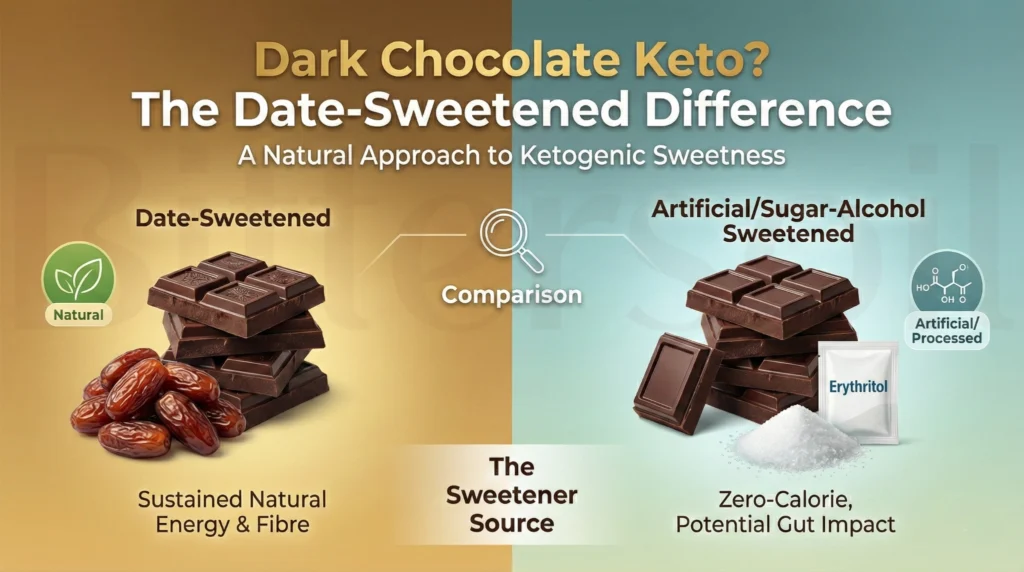
- Date-sweetened dark chocolate provides fiber and healthy fats that support satiety and sustained energy - unlike refined sugar-heavy chocolates.

How Many Calories in Dark Chocolate?
Here are the exact calorie counts you need to know:
Calories by Standard Serving Sizes
| Serving Size | 70% Dark Chocolate | 85% Dark Chocolate | Milk Chocolate (comparison) |
|---|---|---|---|
| 1 square (10g) | 55-60 cal | 58-62 cal | 50-55 cal |
| 1 ounce (28g) | 170 cal | 180 cal | 150 cal |
| 50g bar (standard) | 280-300 cal | 310-320 cal | 265 cal |
| 100g (full bar) | 600 cal | 620 cal | 535 cal |
Quick Reference Guide
Looking for a specific amount?
- 1 piece/square (10g): ~60 calories
- 2 squares (20g): ~120 calories
- 3 squares (30g): ~170 calories
- Half a 100g bar (50g): ~300 calories
- Full 100g bar: ~600 calories
The Short Answer
A typical serving of 70-85% dark chocolate (about 1 ounce or 3 squares) delivers approximately 170 calories.
But here's what most calorie calculators won't tell you: where those calories come from matters far more than the total number.
Why Calorie Counts Vary:
The Cocoa Percentage Factor
Not all dark chocolate has the same calorie content. The cocoa percentage dramatically affects both calories and nutritional profile.
Calories by Cocoa Percentage
| Cocoa % | Calories (per oz/28g) | Sugar | Fat | Fiber |
|---|---|---|---|---|
| 55-60% Dark | 155-160 cal | 14-16g | 9-10g | 2g |
| 70-75% Dark | 170-175 cal | 6-8g | 12-13g | 3-4g |
| 85-90% Dark | 180-185 cal | 2-4g | 14-15g | 4-5g |
| Milk Chocolate | 150-155 cal | 16-18g | 8-9g | 1g |
| White Chocolate | 160 cal | 17-19g | 9-10g | 0g |
Key Insight
Higher cocoa percentages have MORE calories but LESS sugar.
The extra calories come from cocoa butter (a healthy fat) and fiber, not refined sugar. This is why 85% dark chocolate at 180 calories per ounce is significantly more satiating than milk chocolate at 150 calories per ounce.
How Much Energy Is in 50g of Chocolate?
This is one of the most searched questions about chocolate calories. Here's the complete breakdown:
Energy Content in 50g of Dark Chocolate
70% Dark Chocolate
(50g serving)- Calories: 280-300 kcal
- Kilojoules: 1,170-1,255 kJ
- Protein: 4-5g
- Fat: 21-22g (cocoa butter)
- Carbohydrates: 19-21g
- Fiber: 5-7g
- Net Carbs: 14-16g
- Sugar: 6-10g
85% Dark Chocolate
(50g serving)- Calories: 310-320 kcal
- Kilojoules: 1,297-1,339 kJ
- Protein: 5-6g
- Fat: 26-27g (healthy fats)
- Carbohydrates: 12-14g
- Fiber: 7-8g
- Net Carbs: 5-7g
- Sugar: 2-4g
What Can 50g of Dark Chocolate Fuel?
A 50g serving (280-300 calories) provides enough energy for:
| Activity | Duration | Why It Works |
|---|---|---|
| 🏃 Running moderate pace | 25-30 min | Theobromine improves oxygen flow; natural caffeine provides alertness. |
| 🏋️ Weight training | 45-50 min | Magnesium supports muscle contraction and recovery. |
| 🚴 Cycling moderate | 35-40 min | Sustained energy from fat and carbs without sugar crash. |
| 🧘 Yoga/Pilates | 60-75 min | Flavonoids support blood flow and circulation. |
| 💻 Deep Focus | 3-4 hours | Theobromine + mild caffeine (20-30mg) supports concentration. |
| 🏊 Swimming | 20-25 min | Dense calorie source for high-energy expenditure activities. |
Important: These are approximate equivalents based on average energy expenditure. Individual results vary based on body weight, fitness level, and intensity.
Beyond the Number:
Why Dark Chocolate Calories Are Different
Here's where most nutrition labels mislead you. Look at this comparison:
300 Calorie Comparison: What Your Body Actually Gets
| Food Source | Calories | Fiber | Healthy Fats | Sugar Type | Satiety | Blood Sugar |
|---|---|---|---|---|---|---|
| Date-Sweetened 70% Dark Choc (50g) | 300 | 6-7g | 22g (cocoa butter) | Natural (dates, GI 42) | 2-3 hrs | Gradual rise, stable |
| Milk Chocolate Bar (55g) | 300 | 1g | 17g | Refined (GI 65) | 45-60 min | Rapid spike, crash |
| 3 Cookies (Oreos) | 300 | 1g | 13g | Refined + HFCS | 30-45 min | Sharp spike |
| Granola Bar (2 bars) | 300 | 2g | 8g | Corn syrup | 60 min | Moderate spike |
| 1 Samosa | 300 | 2g | 15g (fried oil) | Refined flour | 90 min | High spike |
The Difference Is Clear
The 300 calories from date-sweetened dark chocolate deliver:
- 7x more fiber than milk chocolate
- Healthy monounsaturated fats (cocoa butter) vs. inflammatory oils
- 50% longer satiety (keeps you full 2-3 hours vs. 45 minutes)
- Gradual blood sugar response (GI 42 vs. GI 65+ for refined sugar)
This is why you can eat 300 calories of quality dark chocolate and feel satisfied, while 300 calories of cookies leave you hungry an hour later.
The Thermic Effect of Food (TEF)
Your body burns calories just to digest food. This is called the Thermic Effect of Food.
Energy Cost to Digest 100 Calories:
- Refined sugar/simple carbs: 5-10 calories burned (5-10%)
- Protein: 20-30 calories burned (20-30%)
- Fiber-rich foods (dates, cacao): 15-20 calories burned (15-20%)
Translation: Your body works harder to digest date-sweetened chocolate than milk chocolate. The net calorie impact is actually lower than the label suggests.
Research shows that fiber can slow glucose absorption by up to 30%, meaning the calories are released gradually rather than flooding your bloodstream all at once.
Dark Chocolate Calories and Weight Loss:
What the Science Says
If you're eating chocolate while trying to lose weight, you need to understand the relationship between calorie quality and metabolic response.
The Insulin Factor
When you eat chocolate sweetened with refined sugar:
- Blood glucose spikes rapidly (within 15-30 minutes)
- Pancreas releases large insulin surge
- Glucose is quickly stored as fat
- Blood sugar crashes (60-90 minutes later)
- You feel hungry again and crave more sugar
When you eat date-sweetened dark chocolate:
- Blood glucose rises gradually (over 45-60 minutes)
- Pancreas releases moderate, sustained insulin
- Glucose is used for energy, excess stored as glycogen
- Blood sugar declines slowly (over 2-3 hours)
- You stay satisfied and avoid cravings
The Satiety Research
Studies show that whole-food sources trigger satiety signals that are up to 40% stronger than refined sugar alternatives.
This means:
- Date-sweetened chocolate: Satisfies with 2-3 squares (60-90 calories)
- Milk chocolate: Requires 5-6 squares (150-180 calories) for same satisfaction
Real-World Example: The 30-Day Comparison
Scenario A:
Daily Milk Chocolate Snack
- 6 squares (60g) = 320 calories
- Daily habit = 2,240 calories/week
- Monthly = 9,600 calories
- Weight impact: +1.2 kg/month (assuming no other changes)
Scenario B:
Daily Date-Sweetened Dark Chocolate Snack
- 3 squares (30g) = 165 calories (satisfied with less due to satiety)
- Daily habit = 1,155 calories/week
- Monthly = 4,950 calories
- Weight impact: +0.6 kg/month
Difference:
4,650 fewer calories per month = 0.6 kg less weight gain
This doesn't account for improved insulin sensitivity and reduced cravings from avoiding refined sugar.
Stop Counting, Start Fueling
If you're staring at the back of a chocolate wrapper, you're probably asking one question: "Will this ruin my diet?"
It's the wrong question.
When it comes to calories in dark chocolate and weight loss, the number on the label tells you almost nothing about how your body will respond. In nutrition, calories are not interchangeable units.
The body responds very differently to 100 calories of refined sugar versus 100 calories from cacao and whole fruit.
Refined sugar is absorbed rapidly, often triggering sharp insulin responses and short-lived energy. Cacao and dates digest more slowly, delivering energy alongside fiber and fats that promote fullness.
The Numbers: Dark Chocolate vs. the Rest
Let's look at the data. Below is a comparison based on a standard 30g serving (about 3 squares).
| Chocolate Type | Calories | Sugar (g) | Fiber | Response |
|---|---|---|---|---|
| Bittersoil 70% (Date Sweetened) | ~165 | 6g (natural) | High | Stable, sustained |
| Standard Milk Chocolate | ~175 | 18g (refined) | Low | Rapid spike & drop |
| White Chocolate | ~180 | 20g (refined) | 0 | Short-lived energy |
| 90% Ultra Dark | ~185 | 2g | Very High | Intense, low sugar |
The Takeaway
Notice how similar the calorie counts are?
This is where most people get misled. Milk chocolate calories are dominated by refined sugar. Date-sweetened dark chocolate calories come primarily from cocoa butter (fats) and dates (fiber) - a combination that slows digestion and supports satiety.
The Science: Why Date-Based Calories Feel Different
Why can you eat 300 calories of dark chocolate and feel satisfied, but eat 300 calories of candy and still want more? Two mechanisms explain the difference.
1. The Thermic Effect of Food (TEF)
Your body uses energy to digest food. Refined sugar requires minimal effort to digest. Dates and cacao, however, require metabolic work due to their fiber content and complex fats. Research suggests fiber can slow glucose absorption by up to 30%, meaning digestion itself becomes a form of energy regulation.
2. Satiety Signaling
Dates provide soluble fiber, and cacao contains stearic acid (a healthy fat). Together, they trigger satiety signals that tell your brain: "I've had enough." Studies show whole-food sources trigger satiety signals that are up to 40% stronger than refined sugar alternatives.
Activity Context: How Chocolate Fuels Movement
This is not about "burning off" food. It's about understanding how food fuels different kinds of activity. A full 50g bar (~280 calories) can support:
Theobromine supports oxygen flow and cardiovascular performance.
Magnesium supports muscle function and recovery.
Flavonoids support circulation and blood flow.
Mild caffeine combined with healthy fats supports sustained focus.
Weight Loss Context: Quality Over Quantity
If you're evaluating dark chocolate for weight loss, the question isn't "Should I eliminate these calories?" The question is: "What are these calories doing for my metabolism?"
The Insulin Difference: When you eat date-sweetened dark chocolate with fiber intact, the insulin response is moderated. Blood sugar rises gradually and falls slowly.
The Result: You stay satisfied longer and are less likely to reach for additional snacks.
The Bottom Line
- Calories alone don't predict how your body responds - 280 calories of dark chocolate delivers nutrients that refined sugar can't match.
- Date-sweetened chocolate supports satiety through fiber and a moderate glycemic response (GI 42).
- Context matters: dark chocolate is functional fuel for running, lifting, or working - not just a guilty pleasure.
Ready to Fuel Smarter?
Experience chocolate designed for performance. 280 calories of sustained energy per bar - no crashes.
Shop 70% Dark Chocolate Read Next: Why We Don't Use Stevia