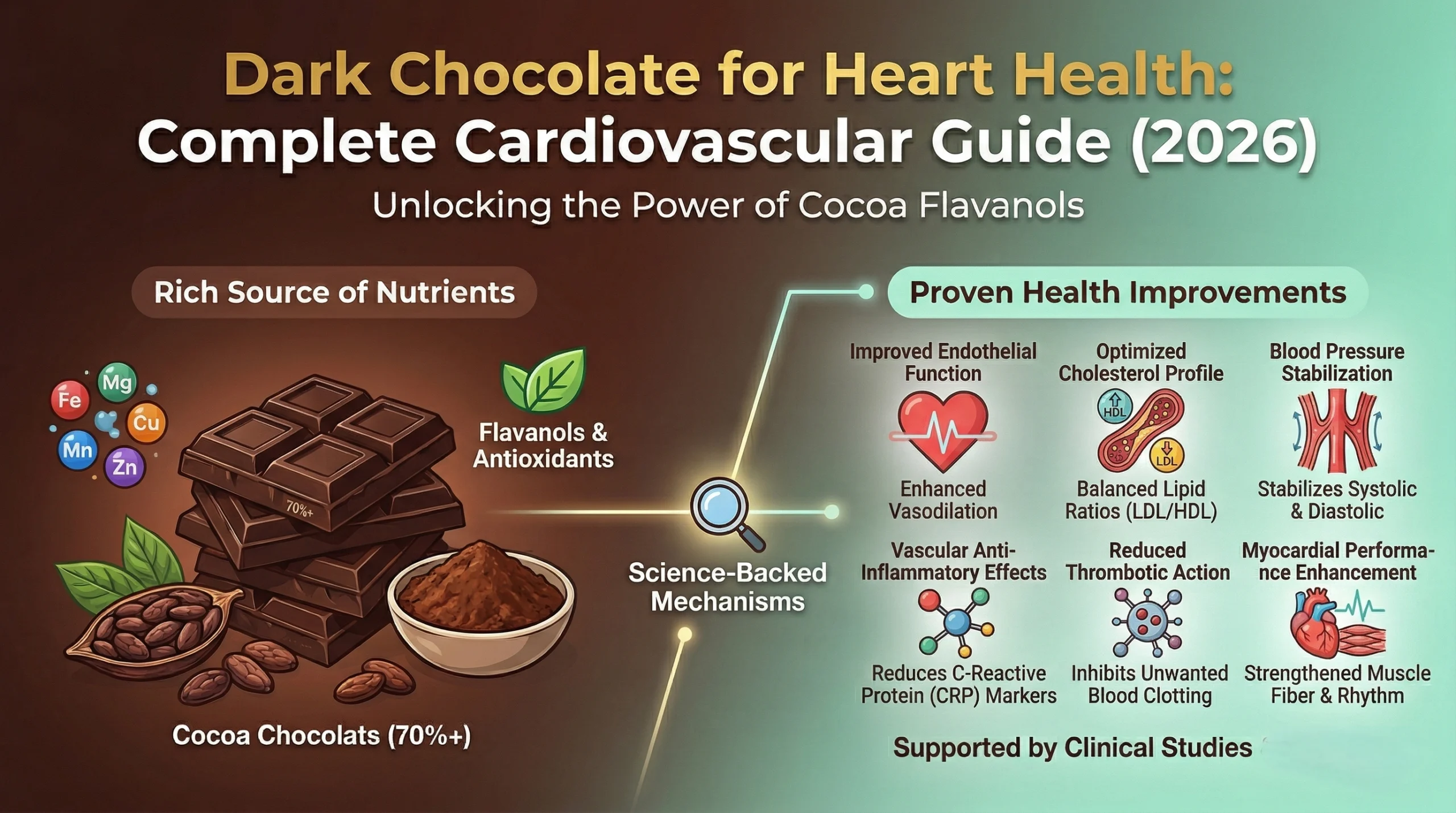
- Dark chocolate consumption reduces essential hypertension risk by 27% and lowers both systolic and diastolic blood pressure through nitric oxide production (2024 Mendelian randomization study)
- Flavanols in 70%+ dark chocolate improve endothelial function, reduce LDL oxidation, inhibit dangerous blood clot formation, and support healthy cholesterol levels
- India faces the world's highest cardiovascular disease burden with 28% of all deaths-making evidence-based dietary interventions like moderate dark chocolate consumption (20-30g daily) particularly relevant
Why Heart Health Matters More in India
Cardiovascular disease (CVD) isn't just a health problem in India-it's a crisis.
Heart disease accounts for 28% of all deaths in India, making it the nation's leading killer. India experiences one of the highest burdens of cardiovascular disease globally, with rates continuing to rise despite public health efforts.
The numbers are staggering: an estimated 54.5 million Indians currently live with some form of cardiovascular disease. That's more than the entire population of South Korea.
What makes this particularly concerning is the age factor. Indians develop heart disease 10-15 years earlier than Western populations. Heart attacks in the 30s and 40s-once rare-have become tragically common in urban India.
The traditional risk factors drive this epidemic: hypertension (affecting 220 million Indians), diabetes (77 million), obesity, smoking, and sedentary lifestyles accelerated by desk jobs and urban environments.
This is where dark chocolate enters the conversation-not as a miracle cure, but as one evidence-based dietary component that may support cardiovascular health when consumed appropriately.
How Dark Chocolate Protects Your Heart: The Mechanisms
Dark chocolate doesn't work through a single pathway. Research has identified multiple mechanisms through which cocoa flavanols support cardiovascular function.
The Nitric Oxide Connection
The primary mechanism centers on nitric oxide (NO)-a molecule that plays a critical role in vascular health.
Flavanols in dark chocolate activate nitric oxide synthase in endothelial cells (the cells lining blood vessels). This enzyme produces nitric oxide, which then signals smooth muscle cells in blood vessel walls to relax.
A 2024 Mendelian randomization study published in Scientific Reports found that genetically predicted dark chocolate intake was significantly associated with reduced risk of essential hypertension, with an odds ratio of 0.73 (meaning 27% risk reduction).
What this means practically: When blood vessels can relax and dilate efficiently, blood flows more easily. Your heart doesn't have to work as hard to pump blood through your system. Blood pressure decreases. Cardiovascular strain reduces.
Endothelial Function Improvement
The endothelium-the inner lining of blood vessels-acts as a critical interface between your bloodstream and vessel walls. When endothelial function deteriorates, cardiovascular disease risk increases dramatically.
Multiple randomized controlled trials have demonstrated that dark chocolate improves endothelial function:
- A study involving 45 participants found that acute ingestion of dark chocolate significantly improved flow-mediated dilation (FMD)-the gold standard measurement of endothelial function-compared to placebo.
- Even more remarkably, a trial involving 22 heart transplant recipients showed that dark chocolate intake significantly increased coronary artery diameter and improved endothelium-dependent coronary vasodilation.
Context for India: Given that Indians develop endothelial dysfunction earlier than Western populations, interventions that support endothelial health from younger ages may be particularly valuable.
Source: RCT studies published in cardiovascular journals (2024)Anti-Inflammatory Effects
Chronic inflammation underlies atherosclerosis-the buildup of plaque in arteries that leads to heart attacks and strokes.
Cocoa polyphenols have demonstrated anti-inflammatory properties in multiple studies. They modulate immune system responses and suppress production of pro-inflammatory cytokines-signaling molecules that promote inflammation throughout the cardiovascular system.
Research shows that regular dark chocolate consumption reduces systemic inflammation markers, potentially slowing atherosclerotic progression.
Blood Pressure: The Hypertension Connection
High blood pressure silently damages blood vessels, heart, kidneys, and brain over years. It's called the "silent killer" because most people feel fine while their cardiovascular system deteriorates.
An estimated 220 million Indians have hypertension, but only 15-20% have it adequately controlled. Most don't even know they have it.
The Research Evidence
A 2022 systematic review and meta-analysis examined 31 studies on cocoa flavonoids and blood pressure. The conclusion: consuming cocoa beverages or chocolate for more than 2 weeks was associated with reductions in both systolic and diastolic blood pressure.
The effect size was modest-typically 2-5 mmHg reduction in systolic pressure-but meaningful at a population level.
A cross-sectional study involving 14,310 Jordanian adults found that dark chocolate intake had significant beneficial effects on blood pressure in healthy adults.
One clinical trial showed that consuming just 15g of 85% dark chocolate daily led to measurable blood pressure reductions among hypertensive adults. The effect occurred within 30 minutes and lasted several hours.
The Kuna Indian Evidence
Perhaps the most compelling population evidence comes from the Kuna Indians of Panama, who traditionally consume large amounts of cocoa.
The Kuna have exceptionally low rates of hypertension and cardiovascular disease-until they migrate to urban areas. When Kuna Indians moved to cities, their blood pressure increased significantly.
Researchers attributed this change to decreased cocoa consumption following cultural shifts, suggesting that dietary cocoa played a protective role against hypertension development.
Source: Kuna Indian population studies; systematic review Cochrane Database (2022)Important Medical Context
Dark chocolate should complement, not replace, prescribed blood pressure medications. If you have hypertension, continue your medications as prescribed and discuss dietary changes with your cardiologist.
The blood pressure reductions from dark chocolate are modest-helpful as part of a comprehensive approach but insufficient as standalone treatment for stage 2 hypertension (systolic ≥140 mmHg).
Cholesterol Management: LDL, HDL, and Oxidation
Cholesterol's role in heart disease is more nuanced than "good vs. bad" cholesterol. What matters is not just LDL levels, but LDL oxidation-the process that makes cholesterol dangerous.
How Dark Chocolate Affects Cholesterol
Research demonstrates that dark chocolate influences cholesterol profiles in several ways:
- Reduces LDL Oxidation Oxidized LDL is particularly harmful because it contributes directly to atherosclerotic plaque formation. Dark chocolate's antioxidants help prevent LDL oxidation. A 2017 review in the Journal of Nutritional Science found that dark chocolate consumption reduced LDL oxidation while improving HDL function.
- May Increase HDL ("Good") Cholesterol Some studies have shown modest increases in HDL cholesterol following regular dark chocolate consumption. HDL helps remove cholesterol from arteries and transport it to the liver for elimination.
- Improves Apolipoprotein Profile A 2017 study found that consumption of almonds combined with dark chocolate and cocoa resulted in significant reductions in small, dense LDL particles, apoB (a marker of cardiovascular risk), and the apoB-to-apoAI ratio.
The Fat Profile Advantage
Dark chocolate's cardiovascular benefits partly stem from its fatty acid composition:
- Oleic acid (33%): Heart-healthy monounsaturated fat (same as olive oil)
- Stearic acid (33%): Saturated fat that converts to oleic acid in the body, maintaining neutral effects on cholesterol
- Palmitic acid (33%): The only potentially problematic saturated fat, but comprising just one-third of total fat
This unique fat profile means dark chocolate's saturated fat doesn't raise LDL cholesterol as dramatically as other saturated fat sources.
Source: Journal of the American Heart Association study (2017)Blood Clot Prevention: Platelet Function
Blood clots can be lifesaving when they stop bleeding from injuries. But inappropriate clot formation inside arteries can cause heart attacks and strokes.
How Dark Chocolate Affects Platelets
Research has demonstrated that cocoa flavanols influence platelet function in beneficial ways:
- A study gave participants a cocoa beverage containing 897mg of epicatechin and oligomeric procyanidins. Blood drawn 2 hours later showed significantly reduced platelet activation markers when stimulated with epinephrine and ADP.
- Cocoa also inhibited coagulation by reducing formation of hemostatically active platelet microparticles and increasing platelet-related hemostasis time.
- Another study evaluated platelet function in smokers 2 hours after consuming 40g of dark chocolate. Platelet adherence under shear stress (mimicking severely stenotic or disrupted plaques) was significantly reduced by 5%.
The Aspirin Similarity
Previous studies have shown that flavanols have physiological effects similar to aspirin in inhibiting cyclooxygenase-the enzyme involved in platelet aggregation.
Important medical note: This doesn't mean dark chocolate replaces aspirin therapy. If your cardiologist has prescribed daily aspirin for cardiovascular protection, continue it as directed. Dark chocolate provides complementary, not substitute, antiplatelet effects.
Arrhythmia and Venous Thromboembolism
The cardiovascular benefits of dark chocolate may extend beyond the commonly discussed effects.
Suggestive Evidence on VTE
The 2024 Mendelian randomization study found a suggestive association between dark chocolate intake and reduced risk of venous thromboembolism (VTE)-blood clots in veins-with an odds ratio of 0.69 (31% risk reduction).
However, the analysis showed some evidence of horizontal pleiotropy, meaning other genetic factors might confound this relationship. More research is needed to establish causality definitively.
What About Other Heart Conditions?
The same study found no significant association between dark chocolate intake and:
- Heart failure (HF)
- Coronary heart disease (CHD)
- Myocardial infarction (MI)
- Atrial fibrillation (AF)
- Non-rheumatic valvular heart disease
- Stroke or ischemic stroke
Interpretation: Dark chocolate shows strongest evidence for blood pressure reduction and endothelial function improvement. Claims about preventing heart attacks or strokes directly are not yet supported by genetic causality studies.
Source: Scientific Reports Mendelian randomization study (2024)Optimal Dosing for Cardiovascular Benefits
How much dark chocolate actually provides cardiovascular benefits without excessive calories?
Evidence-Based Recommendations
Most studies showing cardiovascular benefits used doses ranging from 15g to 100g daily. The optimal balance appears to be:
Minimum Effective Dose: 15-20g daily
(approximately 1.5-2 squares)
- Provides measurable flavanol intake
- Minimal caloric impact (~90-110 calories)
- Sustainable long-term
Optimal Dose: 20-30g daily
(approximately 2-3 squares)
- Balances cardiovascular benefits with calorie control
- Provides 150-200mg flavanols (depending on cocoa percentage and processing)
- Used in many successful clinical trials
Upper Limit: 50g daily
(approximately 300 calories)
- Higher doses don't provide proportionally greater benefits
- Caloric load becomes significant
- May contribute to weight gain if not accounted for in total diet
Timing Considerations
Some research suggests consuming dark chocolate earlier in the day may be preferable:
- Mild caffeine content (20-30mg per ounce) won't interfere with sleep
- Flavanol absorption may be optimized when consumed with or after a meal containing healthy fats
- Spreading consumption throughout the day (morning and afternoon) may provide more sustained nitric oxide effects
The Indian Context: Unique Cardiovascular Challenges
India's cardiovascular disease burden differs from Western patterns in important ways.
Earlier Age of Onset
Indians develop coronary artery disease 10-15 years earlier than Europeans. Heart attacks in the 30s and 40s-rare in the West-are common in India.
This earlier onset means preventive strategies should ideally begin in the 20s and 30s, not the 50s.
Metabolic Syndrome Prevalence
Indians are genetically predisposed to central obesity, insulin resistance, and metabolic syndrome-all cardiovascular risk factors. An estimated 30-40% of urban Indians meet metabolic syndrome criteria.
Dark chocolate's potential benefits for insulin sensitivity and inflammation may be particularly relevant for this population.
Dietary Transition
Traditional Indian diets rich in whole grains, legumes, vegetables, and spices provided cardiovascular protection. As processed foods, refined oils, and sugar consumption increase, cardiovascular disease rates climb.
Incorporating small amounts of quality dark chocolate fits within a whole-food dietary framework, unlike ultra-processed snacks.
Cost-Benefit Analysis
Premium dark chocolate costs ₹4-6 per gram. At 20-30g daily, that's ₹80-180 per day or ₹2,400-5,400 monthly.
Compare this to:
- Average cardiovascular disease treatment costs: ₹50,000-200,000 annually
- Cardiac stent procedure: ₹150,000-300,000
- Bypass surgery: ₹300,000-600,000
Investing in prevention through diet quality-including moderate dark chocolate consumption-is far less expensive than treating advanced cardiovascular disease.
Date-Sweetened vs. Sugar-Sweetened: The Cardiovascular Difference
Most cardiovascular research uses commercial dark chocolate sweetened with refined sugar. But sweetener type affects overall cardiovascular impact.
Refined Sugar's Cardiovascular Effects
Refined sugar (cane sugar) contributes to:
- Blood sugar spikes and crashes
- Insulin resistance over time
- Inflammation
- Triglyceride elevation
- Weight gain
These effects partially counteract dark chocolate's cardiovascular benefits.
Date Powder Advantages
Date-sweetened chocolate offers:
- Moderate glycemic index (42-55) vs. refined sugar (65)
- Fiber content (approximately 7g per 100g dates) that slows sugar absorption
- Potassium (334mg per 100g dates) supporting blood pressure regulation
- Magnesium supporting vascular function
- No blood sugar crash due to gradual absorption
For people with cardiovascular risk factors-especially those with diabetes, pre-diabetes, or metabolic syndrome-date-sweetened chocolate may provide cardiovascular benefits without the metabolic downsides of refined sugar varieties.
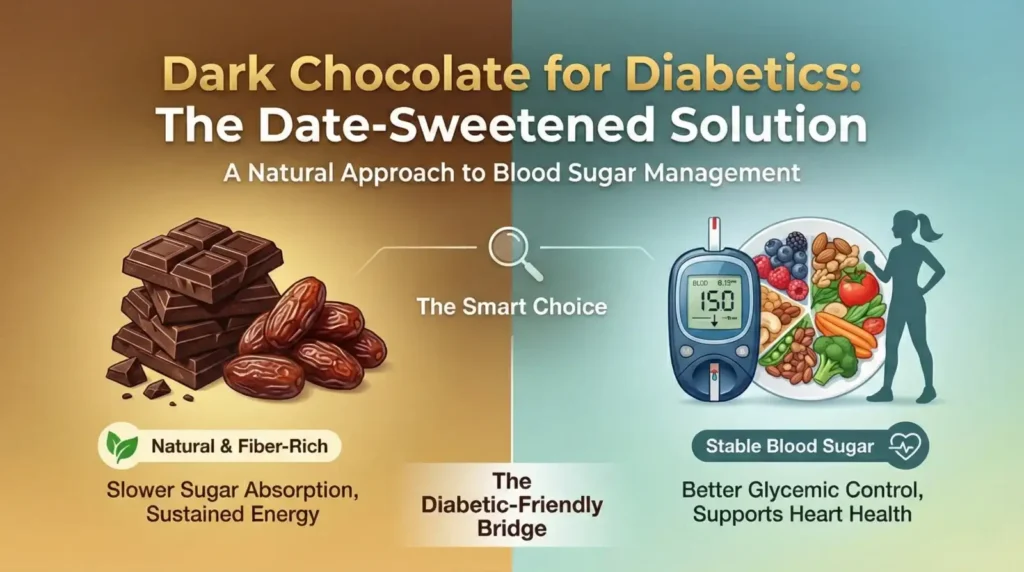
Related reading: Dark Chocolate for Diabetics: The Date-Sweetened SolutionWho Should Be Cautious or Avoid Dark Chocolate
Despite cardiovascular benefits, certain individuals should approach dark chocolate carefully or avoid it entirely.
Heart Failure Patients on Fluid Restriction
Dark chocolate contains theobromine, a mild diuretic. For patients with heart failure on strict fluid management, discuss chocolate consumption with your cardiologist.
Those on Anticoagulants
If you take warfarin, apixaban, or other blood thinners, dark chocolate's mild antiplatelet effects are generally not concerning in moderate amounts (20-30g daily). However, inform your cardiologist about dietary changes.
Individuals with Arrhythmias
Dark chocolate contains caffeine (20-30mg per ounce) and theobromine. Caffeine-sensitive individuals with atrial fibrillation or other arrhythmias should limit consumption or choose lower doses.
Those with Uncontrolled Hypertension
If your blood pressure is significantly elevated (stage 2 hypertension: systolic ≥140 mmHg), prioritize medication compliance, sodium reduction, and weight management. Dark chocolate is supplementary, not primary, therapy.
People with Kidney Disease
Dark chocolate is high in potassium (715mg per 100g). People with chronic kidney disease (CKD) stages 3-5 must limit potassium intake and should consult their nephrologist before regular dark chocolate consumption.
Combining Dark Chocolate with Other Heart-Healthy Foods
Dark chocolate works best as part of a comprehensive dietary pattern, not as an isolated intervention.
The Mediterranean Diet Connection
The Mediterranean diet-rich in olive oil, fish, nuts, vegetables, and whole grains-is the most studied heart-healthy dietary pattern.
Adding dark chocolate to a Mediterranean-style diet may provide synergistic benefits. The PREDIMED trial showed that a Mediterranean diet supplemented with nuts reduced major cardiovascular events by 28%.
Nuts + Dark Chocolate
A 2017 study found that consumption of almonds alone or combined with dark chocolate and cocoa improved lipid/lipoprotein profiles significantly. The combination reduced small, dense LDL particles more effectively than either food alone.
Practical application: Pairing 20-30g dark chocolate with a handful of almonds or walnuts creates a cardiovascular-protective snack.
Source: Journal of the American Heart Association study (2017)Indian Heart-Healthy Combinations
- Dark chocolate + walnuts (omega-3 fatty acids)
- Dark chocolate + almonds + green tea (complementary antioxidants)
- Dark chocolate + berries (additional polyphenols)
- Dark chocolate + cinnamon tea (insulin sensitivity support)
The Bottom Line
- Dark chocolate with 70%+ cocoa reduces essential hypertension risk by 27% and lowers blood pressure through nitric oxide production and improved endothelial function, supported by 2024 Mendelian randomization studies and multiple RCTs.
- India's cardiovascular disease burden-28% of all deaths, with heart disease developing 10-15 years earlier than Western populations-makes evidence-based dietary interventions particularly critical for Indians in their 30s and 40s.
- Optimal cardiovascular benefits occur at 20-30g daily dark chocolate consumption, providing 150-200mg flavanols with manageable calories (110-170 kcal), when combined with Mediterranean-style dietary patterns and regular exercise.
Common Questions About Dark Chocolate and Heart Health
Frequently Asked Questions
Can dark chocolate prevent heart attacks?
How quickly do I see cardiovascular benefits?
Some effects appear rapidly:
- Blood pressure: Reductions observed within 30 minutes to 2 hours
- Endothelial function: Improvements seen within 2 hours of acute ingestion
- Platelet function: Changes detected within 2 hours
Other benefits accumulate over weeks to months:
- Cholesterol effects: Require 2-4 weeks of regular consumption
- Long-term cardiovascular risk reduction: Months to years of consistent intake
Should I take my blood pressure medication with dark chocolate?
Is dark chocolate as effective as exercise for heart health?
Can I eat dark chocolate if I've had a heart attack?
Does the type of cocoa processing matter?
Related Reading
Comprehensive Guide:
- 12 Health Benefits of Dark Chocolate: Science-Backed Guide (2026) - Overview of all cardiovascular, metabolic, and cognitive benefits
Specific Conditions:
- Dark Chocolate for Diabetics: The Date-Sweetened Solution - Managing cardiovascular + diabetes risks simultaneously
- Is Dark Chocolate Keto? The Date-Sweetened Difference - Cardiovascular benefits within ketogenic diets
Complementary Benefits:
- Dark Chocolate for Brain Health: Memory, Focus & Cognitive Function - Cerebrovascular circulation and cognitive effects